
Inspiration
Welcome to our Creative Learning Blog, We believe that creative learning is a powerful tool for unlocking the potential of learning in SEND provision. We explore a range of topics, from sensory-friendly learning environments to innovative teaching strategies that are tailored to the strengths and needs of students including neurodiverse learners. Our blog is written by Nathanael, the founder of Bright Circle Learning, who has been writing about inclusive creative learning for several years.
Throughout our blog, we delve into the latest research and best practices for SEN education, offering insights and advice for teachers, parents, and learners alike. Nathanael’s views have evolved over time, but we’ve kept some of his older posts to show the journey of learning and growth that he’s undergone. We use identity-first language, recognizing that neurodiversity is an inherent part of an individual’s identity and should be celebrated and accommodated, rather than seen as a deficit.
We’re passionate about creating a world where every learner, regardless of their abilities or challenges, has access to a high-quality education that builds positive futures. Join us as we explore the latest trends, share practical tips, and showcase success stories from the world of SEN education.
-
It’s said that to be a poet, you have to go to hell and back.
Another engaging TED talk, this time by Cristina Domenech an educator who talks about her work teaching writing at an Argentinian prison. She tells us how through utilising language and a focused series of workshops the students could access poetry. The workshops enabled a profound level of expression despite a number of participants having limited literacy skills. Domenech focused instead on short poetic examples to empower her students, one of whom joins her near the end of the speech to read his own poetry.
-
“The world needs different kinds of minds to think together” – Temple Grandin
I find a huge number of TED talks fascinating, TED’s ethos to share ‘ideas worth spreading’ makes it a fantastic platform to discover and digest some of the worlds most engaging thinkers. I started my inspiration blog with a short post about Ken Robinson’s talk on ‘How schools kill creativity’.
So it’s no surprise that I’m drawn to yet another brilliant speech, this time by Temple Grandin. Diagnosed with autism as a child, Temple shares with us how her mind works, commenting that she ‘thinks in pictures’. The talk focuses on the benefits of different thinkers and incorporates Temple’s experience of excelling in art and an inspirational science Teacher to validate the point ‘mentors are essential’.
Discussing the need to help students with unique minds to be successful, Temple suggests that facilitators of learning utilise fixations to motivate children, provide specific tasks and ‘light the spark’ with industry professionals.
-
An important part of theatre for children is that it is a shared experience – shared with their adult carers and their peers. – Jackie Tait (Nationaltheatre.org.uk, 2015)
 Jackie is a Primary and Early Years Programme Manager at the National Theatre, the comment above fits alongside a wealth of knowledge that make up part of a digital exhibition available through the google cultural institute. Jackie discusses staging children’s stories at the national theatre and the benefit of theatre that is created for all ages. She uses pantomime as an example of surviving theatre, highlighting the ‘family experience’.
This Christmas (2015) I was provided with the opportunity to take a class of pupils to a local pantomime, a vast majority of children had never visited the theatre before and it was great to see so many of them experiencing theatre for the first time. More impressive was the level of engagement and questioning skills pupils showed during and after the performance, proving that theatre is still an excellent context for learning and thinking about the world.
You can discover more teaching resources at Nationaltheatre.org.uk, including a wealth of strong resource packs that include works by Shakespeare and a brilliant background pack on The Curious Incident of the Dog in the Night-Time. The pack goes into further detail discussing the individuality and ‘pointless exercise’ of diagnosing Christopher Boone. If you’d like to find out a little more about the play I have summarised my experience of The Curious Incident of the Dog in the Night-Time in my inspiration blog.
-
As part of society we have a fundamental right to make decisions, it’s what makes us human and allows us to shape our lives.
I believe that everyone in our society should be given access to the skills and resources that enable them to make decisions about their own lives. Intensive interaction is one approach that I have used successfully to teach the pre-speech fundamentals of communication to children and adults with severe learning difficulties and/or autism and who are still at an early stage of communication development. I have always found the development of early communication fascinating and incredibly rewarding. Whilst working 1:1 with a pupil with profound and multiple learning disabilities, I was able to witness the positive impact regular intensive interaction had on their communication development.
The approach of Intensive Interaction was developed by a team of staff working at a school for people who have severe learning difficulties on the campus of a large long-stay hospital in southern England, you can find out more about intensive interaction here.
Or watch this brilliant example of the key principles of intensive interaction below:
-
Tablet technology has taken a huge leap in recent years making classrooms increasingly tech savvy with access to an iPad (or similar tablet device) now a common occurrence.
There can be a huge benefit to using technology in a formal or informal learning environment providing the technology is being used to aid the learning. I would suggest you avoid using an iPad simply to tick the ‘using IT’ box on a lesson plan. I’ve seen a lot of really helpful reviews online that discuss some of the best educational apps for the iPad and there are hundreds of useful applications for a range of adults and children, seriously just google them. But the beauty of technology is that a huge number of features come equipped with the device straight from the box. Having led a range of training for using an iPad in a learning environment I thought i’d share my favourite five features with you.
1. Accessibility
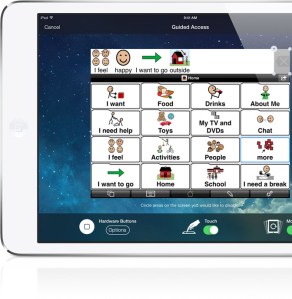
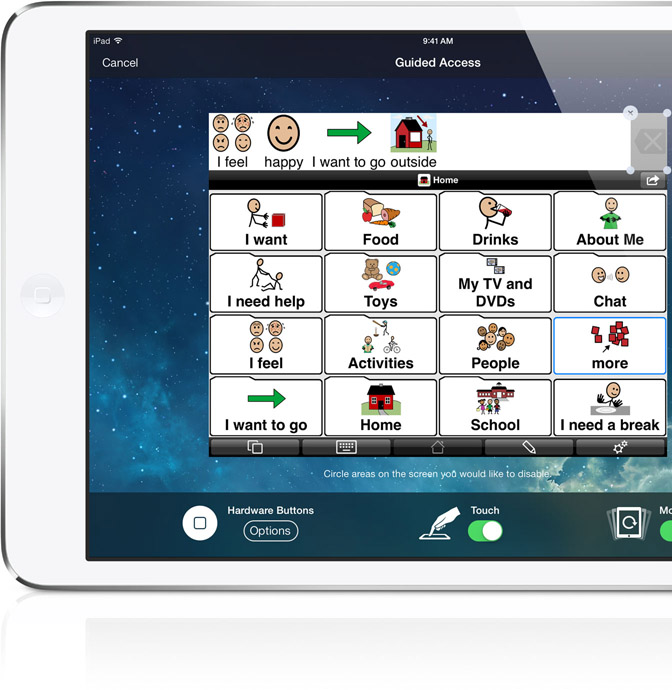
Numero UNO! If i’m honest, it’s a vast range of features but it’s definitely the best thing to happen to tablet technology. Found in the general settings, the ‘accessibility’ features can adapt your iPad to meet a range of needs. Including visual, hearing and physical impairment, some of the guided access functions are particularly helpful when you have pupils who have a tendency to stray from the learning path, apple give an in-depth description of the features here.
 2. The Camera
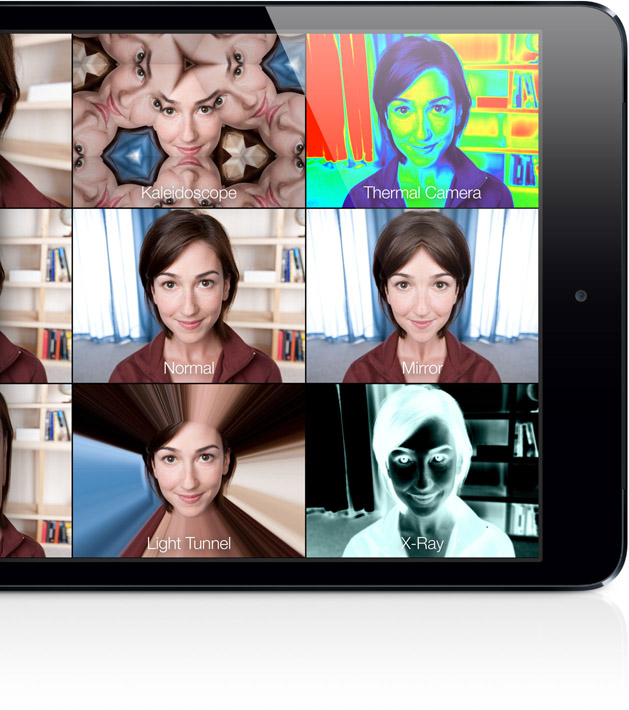
I love the camera on my iPad, It’s a built in assessment and recording device, if you need to quickly gather evidence of an activity you can record or photograph it in just a couple of clicks without even unlocking your device. An added bonus is how the images and video are stored, you can search your library chronologically enabling you to pinpoint specific lessons and even make use of the location services (number 5 on my list) to pinpoint where the photos were taken, particularly useful if you lead a range of workshops at different sites. The camera also comes with a range of image manipulation features, including real time filters (like the ones in photo booth) and post image editing.
3. Internet
Fantastic for searching and using a range of online resources alongside traditional working tools. The benefit of tablet technology is portability and using the internet while on the move has proven incredibly beneficial in extending pupils learning. Whether you’re searching for a range of information from an outdoor environment or simply using the iPad as an extensive dictionary during a group activity it can add tremendous value. Scaffolding the learning experience is very important and the ‘add to home screen’ feature enables you to save webpage urls as ‘application style’ buttons, providing learners with quick access to useful websites.
4. Airplay
Not quite as ‘out the box’ as promised, The airplay feature built into the iPad can have a dynamic impact on your learning environment. Essentially the feature enables you to mirror the device to any computer accessible screen, pupils can become very engaged when watching a recent activity on the class whiteboard, i’ve found this feature incredibly useful when holding mini plenaries to help scaffold the class learning. Taking a quick photograph of a pupil on task and then using the image on the whiteboard to discuss the learning objective and how this pupil is directly meeting the success criteria can be a powerful exercise. It’s fantastic for showcasing drama too by enabling pupils to replay their acting instantly and can turn the iPad into a control for an entire class activity. Apple offers an Apple TV to enable you to airplay to a range of devices, you can also use software like Reflector to turn any mac, PC or Android device into an airplay receiver (there’s a free trail too).
5. Location Services
Last but not least, the iPads built in location services have a range of uses, their brilliant as mentioned above in attaching location information to images. The iPad comes pre-installed with a compass and map function which are brilliant for exploring the local community and lessons or workshops that involve navigation and exploration. You can show a pupil just how far away another country is using an accurate map, track a walk around your local community or even use the iPad in a regional photography workshop to build up a picture map of your local area.
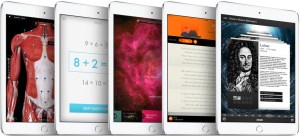
Well it’s certainly not an exhaustive list and by now you can probably guess that I love using technology to aid creative learning. Although I think it’s important we use technology deliberately and not just as a bolt on to a lesson or workshop. I would love to hear your favourite five features or if you’d like to find out more about some of the ones i’ve mentioned. Just leave a comment or contact me directly here.
-
This evening, I stumbled upon a series of videos by motivational speaker Nick Vujicic. Nick talks in-depth about his struggle with disability as a child, both physically and emotionally. He describes how at the age of ten he attempted to commit suicide and how the attempt was a catalyst for him to ‘never to give up’. He often shares his life story and successes to show how his choice led to some amazing changes in his life.
He talks about how importance of life-long learning, using the example that more often than not we learn more from the difficult days rather than the easy ones. He has created a series of short videos titled “Motivational Minute’, which are an excellent starting point when researching methods to motivate your life.
You can watch the “Motivational Minute’ where Nick quickly summarises the importance to ‘Believe in yourself here:
-
Picture the scene, it’s 8:25am, you follow the heard on people to the room for ‘staff training’ where you’re greeted by an image of a grumpy baby on the interactive whiteboard and cheesy music.
In this case the room is an adapted science lab scattered with iPads, for many staff it’s a welcome change to their usual routine but for others there’s an uncertainty. What are they here to learn? How are they going to learn it? And most importantly why are they learning it? This isn’t an uncommon experience particularly when it involves technology, Throughout my experience of leading staff training I often encounter people asking themselves these same questions. As a group I always ensure we visit our learning in the same way that we would approach a good lesson. By first assessing ‘where we are’ and then working out ‘where we want to go’ and ‘how to get there’.
When we work to define the goals, we find that some less experienced staff just want to be able to use a device to improve their daily lives and questions like “How do i turn it on?” aren’t as rare as we might think. But there’s also the young recruit who grew up with technology (of which i’m fortunate to have done) who is keen to get started with the latest programme, test out a bit of code or turn a device into something a little more magical.
That’s why, when reading an article on organising and running a successful workshop, I was encouraged to see that over at the mindtools.com toolkit they have highlighted the need to do exactly that, you can read the full article here.
Like to find out a little more about training I have delivered to adults, including colleagues? Keep your eyes peeled, i’ll be making an addition to my projects page shortly.
-
 How can motivate boys in literacy? Or engage pupils learning English as an Additional Language?
I carried out a research project to examine how to raise engagement when working with a high percentage of pupils learning EAL. Above all else, school staff agreed that good teaching along with effective visual aids could be the most effective, so what better way to engage pupils could there be than to make literacy visual?
We just need a directory with a wide range of visual literacy resources, right? This is where the website literacy shed comes in handy. It’s full of exciting pictures, adverts, animations and story to inspire people, There’s even an inspiration shed, intact everything is sorted into a nice little shed (webpage) for you to find exactly what your looking for all in one place. Each resources is matched up with a short synopsis and teaching suggestions. They make great assembly material and are a brilliant resource for creative writing too!
You can visit the website at www.literacyshed.com
-
I’ve always been interested in the use of media for developing learning resources, in particular methods that make use of the internet and social media. You’ll probably notice that a lot of my posts provide a youtube resource, well that’s pretty much because I love what Youtube has to offer. I’m so in love with it that I even started my own channel.
Saying that however it can be a minefield of information, particularly when you’re hoping to show a short clip during a lesson. Any smart Teacher knows the value of researching and watching a video prior to showing a class full of pupils (If only to check there’s no casual swearing). That’s why I wanted to share BBC Worldwide with you! It’s a brilliant resource with BBC quality content, I’ve particularly enjoyed re-watching the series ‘What the Tudors and Stuarts did for us’ with the engaging Adam Hart-Davis.
The series is available in it’s entirety with the first episode here:
-
Physical theatre is a genre of theatrical performance that pursues storytelling through primarily physical means.
 DV8 are arguably focused on taking risks, aesthetically and physically and their work often breaks down the barriers between dance and theatre to communicating ideas and feelings clearly. DV8 is motivated by artistic inspiration and creative need and I have often found myself returning back to their work for inspiration. Today it was their work ‘The Cost of Living’, a British physical theatre dance film made in 2004 in collaboration with Channel 4. It is an adaptation of their stage production, directed by Lloyd Newson, the founder of DV8 Physical Theatre.
The film uses dance, dialogue and physical theatre to tell the story of two street performers and their interaction with other performers in Cromer, a seaside resort town, at the end of the summer season. The film has won a number of awards.
Watch a short trailer for the film here:



You must be logged in to post a comment.